
Industries We Serve

Long-Horizon Multi-Agent Drug Discovery Simulation Environment
An AI Research & Reinforcement-Learning Initiative for Simulated Scientific Decision-Making

Executive Summary
This document presents an overview of a research project undertaken by Pixelwibes IT Solution Pvt Ltd to design and build a simulated drug-discovery environment in which an AI agent learns, through trial and structured feedback, to conduct a multi-stage pharmaceutical research campaign. The project was developed in-house by our employee as part of Pixelwibes IT Solution Pvt Ltd’s applied AI research efforts and was submitted to the OpenEnv Hackathon (India, 2026), an industry-recognized initiative associated with Hugging Face.
The core deliverable is a working software environment not a real drug discovery tool that recreates the structure, constraints, and decision points of an early-stage pharmaceutical R&D campaign. An AI “agent” (a large language model acting as a virtual Project Lead) is trained inside this environment to plan, prioritize, and make trade-off decisions across a 50-step research process, while a panel of automated specialist reviewers continuously evaluates its choices.
The significance of this work is not the chemistry itself, but the demonstration of a transferable AI capability: training a language model to reason systematically through long, multi-stage, resource-constrained decision processes under expert-style oversight. This capability has direct relevance to a wide range of business domains beyond pharmaceuticals, including R&D portfolio management, regulated investigation workflows, and any structured multi-step business process that currently depends on expert human judgement.
Business Context & Rationale
Modern AI agents are increasingly being asked to perform extended, multi-step work on behalf of organizations not just answer single questions. Before such agents can be trusted with real, high-stakes business processes (such as R&D prioritization, compliance investigations, or multi-stage approvals), their ability to plan, weigh competing constraints, and respond appropriately to expert feedback needs to be developed and measured in a safe, controlled setting.
This project gave Pixelwibes IT Solution Pvt Ltd a low-cost, low-risk testbed for exactly that capability. By simulating a realistic pharmaceutical research campaig complete with budget limits, specialist review, and competing objectives the project allowed the team to study how an AI agent learns to:
- Plan across a long sequence of decisions rather than optimizing one step at a time.
- Balance multiple, sometimes conflicting, success criteria simultaneously (e.g., scientific promise vs. cost vs. safety).
- Operate within a fixed budget of resources/actions, mirroring real project constraints.
These are the same underlying challenges found in many of Pixelwibes IT Solution Pvt Ltd’s other applied-AI initiatives for example, structured document-based compliance review and multi-stage business process automation making this project a useful proving ground for techniques that can later be reused in commercial contexts.
Project Objectives
- Build a realistic, fully simulated drug-discovery research environment that mirrors the stages of an early-stage pharmaceutical campaign, without requiring access to real laboratory infrastructure or proprietary chemical data.
- Design a multi-agent oversight structure in which specialist “sub-agents” (chemistry, toxicology, budget, and compliance/oversight) review every decision made by the lead AI agent in real time.
- Develop a composite scoring framework (a “rubric”) that evaluates the agent on multiple dimensions of quality at once, so that strong performance on one dimension cannot compensate for failure on another.
- Train a language model against this environment using reinforcement learning, and benchmark its learned behaviour against an untrained baseline.
- Package the entire system so it can be run locally, shared with collaborators, or deployed to a public research platform (Hugging Face Spaces) for demonstration and further study.
- Produce the work as a credible, well-documented submission to the OpenEnv Hackathon (India 2026), aligning with multiple official hackathon evaluation themes
Scope
In Scope
- A simulated research environment covering five sequential R&D stages, from target selection through to final candidate nomination.
- An automated panel of specialist reviewer agents that issue guidance and warnings throughout the campaign.
- A multi-factor reward (scoring) system used both to evaluate performance and to train the AI agent.
- A reinforcement-learning training pipeline, including a no-training “random baseline” for fair comparison.
- Deployment tooling so the environment can be run locally, in a hosted notebook, or on a public AI research platform.
Out of Scope
- Real chemical synthesis, laboratory experimentation, or clinical validation. All chemistry-related outputs are produced by a simulation engine and a representative compound library, not by real-world experimentation.
- Regulatory submission, patentability assessment, or any activity intended to support an actual drug approval process.
- Production-grade security hardening or commercial-scale infrastructure; the current build is a research-grade prototype.
Solution Overview
At the centre of the project is a simulated research campaign lasting up to 50 decision steps. An AI agent, acting as the “Project Lead,” must navigate the campaign from start to finish by repeatedly choosing the most appropriate next action much as a real R&D lead would choose between further investigation, refinement, safety screening, or escalation at each point in a project.
The Five-Stage Research Pipeline
The simulated campaign is structured around five stages that mirror the real-world drug discovery process at a conceptual level:
| Stage | Business Objective | Representative Actions |
|---|---|---|
| Target Selection | Identify a viable disease-related biological target | Literature & database research |
| Hit Identification | Find initial candidate compounds | Compound search & binding assessment |
| Hit-to-Lead | Improve candidate potency | Iterative compound refinement |
| ADMET Screening | Filter for drug-likeness and safety | Automated property & toxicity screening |
| Lead Validation | Confirm and nominate a final candidate | Final simulated docking & sign-off |
Every action taken by the agent consumes a portion of a fixed resource budget, requiring it to balance thoroughness against efficiency a direct parallel to real project and cost management.
End-to-End Flow
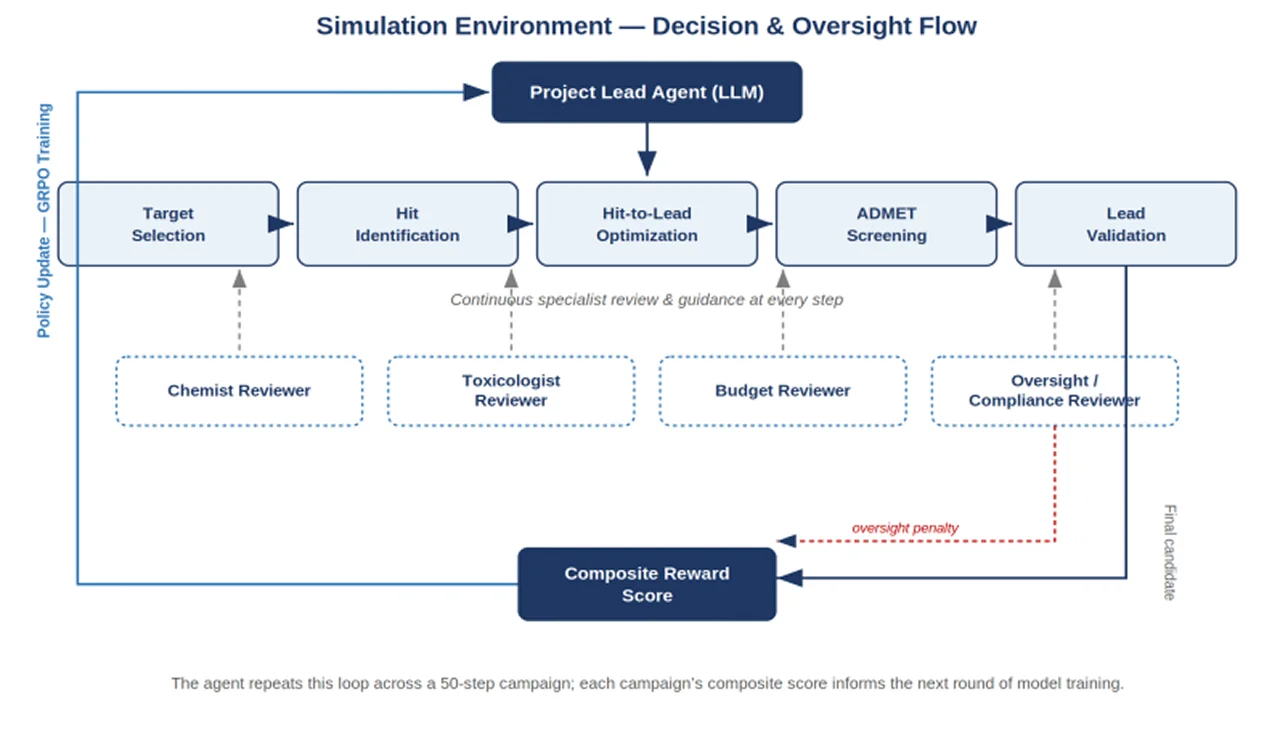
The diagram below illustrates how the Project Lead agent moves through the five stages, how the specialist reviewer panel observes every step, and how the resulting composite score feeds back into model training:
Multi-Agent Oversight Structure
Rather than relying on a single AI making unchecked decisions, the system includes four specialist reviewer agents that observe and respond to every action taken by the lead agent:
- Chemist reviewer: Identifies promising or risky molecular modifications and flags chemically implausible choices.
- Toxicologist reviewer: Screens for safety and toxicity concerns and raises warnings when a candidate looks hazardous.
- Budget reviewer: Monitors resource consumption and warns when the campaign is at risk of running out of budget before completion.
- Oversight reviewer: Acts as a compliance-style checkpoint, with the authority to issue a formal “block” warning; ignoring such a warning carries a direct penalty in the agent’s final score.
This structure was designed deliberately to mirror real organizational governance: a lead decision-maker operating under the active review of domain specialists and a compliance function, rather than in isolation.
Performance & Reward Framework
Agent performance is measured using a composite scoring framework made up of five independently weighted components, so that excelling in one area cannot mask poor performance in another:
| Scoring Component | Weight | What It Measures |
|---|---|---|
| Final Candidate Quality | Primary | Combined effectiveness, safety, and novelty of the nominated candidate |
| Stage Progression | Secondary | Whether the agent completed each stage properly without skipping steps |
| Budget Efficiency | Secondary | How much of the available resource budget remained at completion |
| Reasoning Depth | Secondary | Quality and substance of the agent’s stated scientific reasoning at each step |
| Oversight Penalty | Deduction | Penalty applied whenever a formal compliance warning is ignored |
This design intentionally prevents “gaming” the system for example, an agent that writes detailed reasoning but nominates an unsafe candidate still receives a poor overall score, because final candidate quality dominates the outcome.
Training & Evaluation Approach
Two agent configurations were evaluated against the environment:
- Random baseline: A baseline agent that takes valid but unguided actions, establishing the minimum performance floor any trained system must exceed.
- Trained agent: A language model trained against the environment using a reinforcement-learning technique (Group Relative Policy Optimisation, or GRPO) so that it progressively learns which decisions lead to higher overall scores.
Comparing these two configurations allows the team to demonstrate, with evidence, how much measurable improvement the training process delivers across each of the five scoring dimensions described above.
Technology & Tooling Overview
The project was built using established open-source AI and scientific-computing tools, kept deliberately lightweight so the entire system can be trained and demonstrated on freely available cloud hardware. No proprietary or licensed chemistry data was used.
| Layer | Tooling Used |
|---|---|
| Environment framework | Hugging Face OpenEnv the standard framework used for building trainable AI agent environments |
| Chemistry simulation | RDKit, an open-source cheminformatics toolkit, supplying simulated molecular and binding behaviour |
| Service & API layer | FastAPI for the environment’s web service, with a structured data layer (Pydantic) defining actions and observations |
| Agent model | Qwen2.5-3B-Instruct, an open large language model, used as the trainable Project Lead agent |
| Training method | Group Relative Policy Optimization (GRPO), a reinforcement-learning technique, accelerated using the Unsloth and TRL training libraries |
| Packaging & deployment | Docker containerisation, with one-step deployment to Hugging Face Spaces for public demonstration |
| Experimentation | A hosted notebook environment enabling end-to-end training on free cloud GPU hardware |
Key Outcomes & Deliverables
- A fully functioning, self-contained simulation environment that can be run locally or deployed to the cloud with a single command.
- A documented multi-agent governance model (lead agent plus four specialist reviewers) that is reusable as a design pattern for other oversight-driven AI systems.
- A composite, business-style scoring framework that balances quality, efficiency, process compliance, and reasoning a template applicable well beyond this specific project.
- A reproducible training pipeline with a clear baseline-versus-trained comparison, supporting evidence-based evaluation of agent improvement.
- A complete, hackathon-ready submission aligned to four official evaluation themes of the OpenEnv Hackathon.
Business Value & Strategic Applications
While the project is framed around pharmaceutical research, its underlying design a long-horizon agent operating under specialist oversight, scored on a balanced multi-factor rubric is directly transferable to several areas of commercial interest to Pixelwibes IT Solution Pvt Ltd:
- AML / compliance case investigation: The same oversight-and-rubric pattern can structure how an AI agent triages and investigates compliance cases, with specialist reviewers standing in for legal, risk, and audit functions.
- Business process automation: Multi-stage approval and prioritisation workflows in marketing, sales, or operations automation can use the same long-horizon planning and budget-constraint techniques.
- R&D and portfolio prioritisation: The composite reward design offers a reusable framework for scoring any AI agent on competing business priorities (speed, cost, quality, and compliance) at once.
- Brand and talent visibility: As an externally visible hackathon submission, the project strengthens Pixelwibes IT Solution Pvt Ltd’s positioning in applied AI/agentic-systems research.
Risks, Assumptions & Limitations
- Simulated, not real, chemistry: All chemistry, binding, and toxicity outcomes are produced by simulation, not real laboratory science; results must not be interpreted as pharmacological findings.
- Representative, not exhaustive, data: The compound library used resembles real chemical databases in structure but is not a licensed or exhaustive dataset, so findings cannot be generalised to real-world drug candidates.
- Prototype-stage infrastructure: The current build is a research prototype intended for demonstration and learning, not a hardened, production-scale service.
- Reward-design risk: As with any reinforcement-learning system, there is a risk that a trained agent partially “games” the scoring rubric; the composite, multi-factor scoring design exists specifically to reduce this risk.
Conclusion
This project demonstrates Pixelwibes IT Solution Pvt Ltd’s capability to design and build sophisticated, multi-agent AI training environments that go well beyond simple question-answering systems. By simulating a realistic, constrained, multi-stage research process and training an AI agent under structured specialist oversight, the team has produced a working, well-documented proof of concept with clear and credible applications to real commercial workflows. The project stands both as a strong hackathon submission and as a foundation for future applied AI initiatives at Pixelwibes IT Solution Pvt Ltd.
Our Visual Identity
Explore the design, branding, and user experience behind this project.